
Nature Table
~ A periodic commentary on aspects of wildlife and gardening in and around Cattistock. ~

Photographer: Peter Thompson
Jackdaws in abundance
A seasonal sound heard over parts of Cattistock at the moment is the collective jabbering chatter emanating from a flock of black birds flying over and around the village at both first and last light. These birds are, for the most part, Jackdaws.
Jackdaws are members of the crow family (Corvidae). We have got six different species of corvid that typically breed in or in close vicinity to Cattistock: Jay, Magpie, Jackdaw, Rook, Raven and Carrion Crow. The Jay and Magpie are relatively easily distinguished by way of their more distinctive colouration. You will all recognise the black and white Magpie, with their long tails. The more rarely seen Jays, a woodland specialist, are mostly a buffy brown colour and, at close inspection, can be seen to have a wonderfully iridescent blue patch of features on their wings. Jackdaws, Rooks, Ravens and Carrion Crows are largely black.
Of our black corvids, the Jackdaw is the smallest – larger than a Blackbird, smaller than a Woodpigeon. I think they’re rather a smart bird, quite compact with a silvery grey nape (back of the neck) in contrast to a black cap and piercing steely blue-grey eyes. Rooks and Carrion Crows are roughly the same size (similar to Woodpigeon) and can be difficult to distinguish – Rooks, when compared to Carrion Crows, can look to have a comparatively smaller head with a larger, distinctively grey, more pointed beak. Ravens are our largest corvid, with a great stout beak, a slightly diamond-shaped tail and have a characteristic croaking call you might hear as they fly over the village (in ecological function, they are our island’s closest match to a vulture).
When breeding, in the spring/summer, our corvids are generally territorial. The social Rook is the exemption to the rule, nesting collectively in a rookery, as can be seen and heard in the roadside trees on the edge of Cattistock’s cricket ground. With Carrion Crows and Magpies being amongst the most fiercely territorial during the breeding season, Jackdaws are more relaxed and can nest in close proximity to each other. St. Peter and St. Paul’s is a popular nesting site for Jackdaws, as evidenced by the litter of sticks around the church in the spring; twigs are dropped after birds fail to incorporate them into their nest cavities between the louvres (the gaps in the tower that allows the church bells to be better heard). Holes in any remaining ancient or veteran trees are prized nesting sites – as are our chimney pots!
Jackdaws principally collaborate in pairs in spring, to collect food to feed their young. Protein-rich food is at the top of the shopping list, to promote healthy fast-growing chicks. Corvids can be ill regarded for their dietary choices – Magpies and Carrion Crows infamously eating the eggs and chicks of other birds. As referenced above, they are simply striving for high quality food. Steak is a favourite food of mine, Blue Tits feed their chicks protein-rich caterpillars (baby moths) and corvids do their thing. In the case of Jackdaws, their diet varies and includes seeds, grains and berries and insects, worms, slugs and snails – and may also include a few eggs and chicks.
As we move into autumn the Jackdaw’s greater focus on their immediate family dissipates and their gregarious nature comes to the fore. Autumn and winter are when the size of their flocks are at their greatest – and we see and hear Jackdaws circling and flying back and forth at dusk, preparing to roost – or having a charge around together in early morning after leaving their roost, before going about their daily tasks of finding food. If you look or listen hard, you may note that these flocks are often a combination of both Jackdaws and Rooks. Why join forces and roost together? We presume their collective behaviour helps reduce instances of predation; I saw a Goshawk flying over the village recently – an apex predator capable of hunting most corvids.
After taking a photo and counting individuals, I know that our local flock of Jackdaws and Rooks can exceed 1,000 birds at this time of year. Whilst I write ‘flock’, an aggregation of Jackdaws can be referred to as a clattering (an appropriate reflection of their noise), a train (presumably referring to their flight formation at times) a band or a cast. The collective noun for Rooks being a parliament, a building or a clamour.
Our 1,000 strong flock appears to be a collection of smaller groups of Jackdaws and Rooks from different local districts. As the evening light begins to fade, a starting flock, for example a core of Cattistock birds, does the circuit around the village before being periodically joined by incoming flocks that gradually swell the numbers. When darkness is near the flock’s size is at its greatest and their fantastic swirling formation moves west from over our village to a nearby block of woodland, which they all drop down into to spend the night. In the next couple of weeks, as we move into spring, the size of this twilight mega flock (a term I’ve made up) will lessen, as individuals, pairs and groups of Jackdaws think more about breeding and parenthood and will roost more locally to their nest sites in neighbouring districts and villages.
~ ~ ~ ~ ~ ~ ~ ~ ~ ~ ~ ~ ~ ~ ~ ~ ~ ~ ~ ~ ~ ~ ~ ~ ~ ~ ~ ~ ~ ~ ~ ~ ~ ~ ~ ~ ~ ~ ~ ~ ~ ~ ~ ~ ~ ~ ~ ~ ~ ~ ~ ~ ~ ~ ~ ~ ~ ~ ~ ~ ~ ~ ~
A diary entry from December:
Early December and Mildly Confusing!
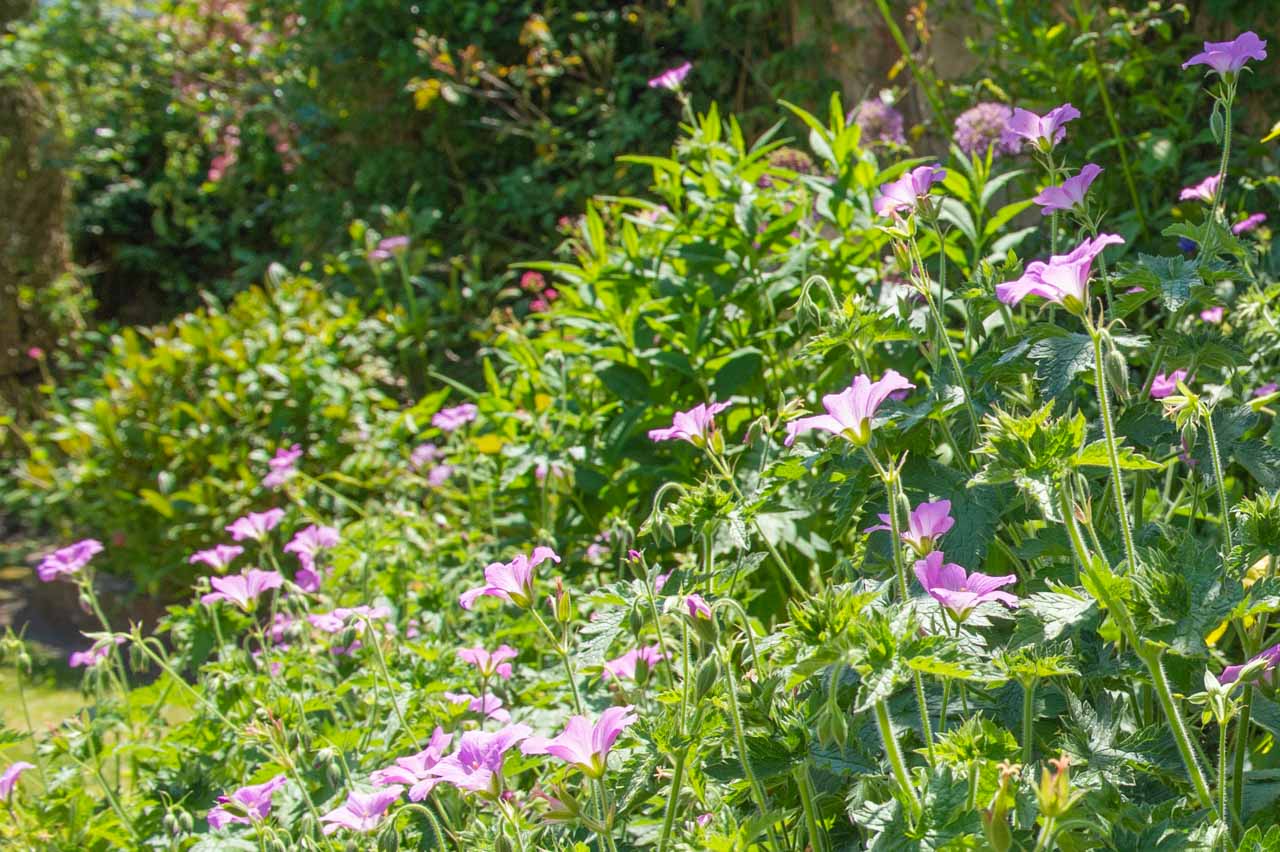
Up until the last two mornings when we awoke to the second whitest of white frosts, I’ve been picking bunches of roses – a couple of bearded iris, three primroses, hardy geraniums and today, Anemone ‘Fokker’ deep purple on tall stems. Crazy.
The only shrub that is flowering as it should are the two gigantic mahonias, blessedly covered with flowers, sustaining the bees – the busy humming is magically deafening and cheerful.
What an incredible autumn for apples – even better, pears, and we had the heaviest crop of walnuts ever and then squirrels gathering, running along the telephone wires in the orchard field from tree to tree carrying a walnut in their mouth and burying them in the long border.
Now they are trying their luck on the various bird feeders but I’m now one step ahead! I’m hanging the feeders on long wires, no-go zone for the likes of them.
Scilly Flowers have begun deliveries from the islands – a wonderful scent permeates the house, it is good to have a fore-runner of Spring even if there is still Christmas to look forward to.
Pictures shown are from previous years.


THE WILDLIFE OF CATTISTOCK, OVERVIEW:
Most Dorset villages offer diverse habitats for native flora and fauna, but Cattistock offers more than most. Almost every dwelling has a garden, and many of them are managed for the benefit of birds and insects as well as us humans.
The contingent farmland is mainly pasture, dotted with copses and criss-crossed with footpaths – plenty of scope for the now-rare farmland birds, and the opportunity to spot them. Our valley, Lankham Bottom, is a noted butterfly reserve, with glow-worms on its chalk escarpments too.
At the heart of the village is the church and churchyard, a central green space seething with wildlife if you know where to look. On summer evenings at least five species of bat whirl above your head, while the swifts which nest in the church buildings speed shrieking around the rooftops as dusk falls. Some of the churchyard’s most famous visitors are the hawfinches which flock in winter to the magnificent row of hornbeams which border its south side, and following them the flocks of bird-watchers from all over the county. Dog-walkers sometimes encounter the now rare hedgehog foraging among the graves at night. In spring and summer the graveyard is a carpet of wild flowers, and the church’s programme of grass cutting is managed to ensure that they continue to proliferate.
The Friends of Cattistock church aim to implement a scheme to increase habitats for wildlife of all kinds around the church, perhaps in time to acquire a gold medal for conservation from the Eco Church Foundation.
NATURE TABLE ARCHIVES
To see the image archive enter here
Previous years Nature Table articles can be viewed below:
For 2025 enter here
For 2024 enter here
For 2023 enter here
For 2022 enter here
For 2021 enter here
For 2020 enter here
For 2019 enter here
Last Updated on 12th February 2026